
AI is the orchestra. Be the Conductor.
Dozens of talented players, all performing at once, each following their own instincts, with nobody setting the tempo. That is not music. That is what AI sounds like inside most organizations right now. This book is the score, and a step-by-step guide to picking up the baton.
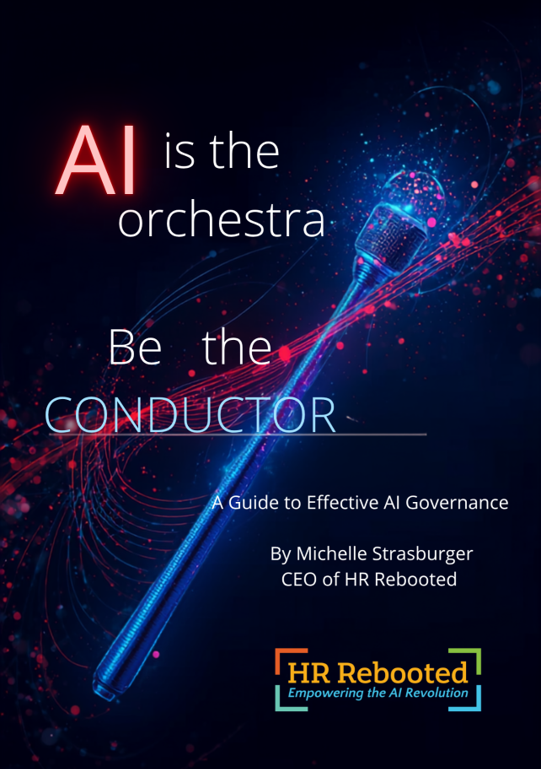
15 Chapters. 7 Steps. 1 Podium.
Michelle Strasburger has spent more than two decades leading HR through the changes nobody had a playbook for. This book is the playbook she wished existed for the current one: a practical, NIST-aligned framework that takes an organization from scattered AI experimentation to governed, confident, everyday use.
Coming 2026.
Somebody in your organization shipped an AI decision you never saw.
Not out of malice. Out of momentum. The tools are free, the work is real, and nobody put up a stop sign. The gap between what leadership believes is happening with AI and what is actually happening on the ground is where legal risk, reputational damage, and operational chaos take root.
“AI is an orchestra without a conductor.”
The book takes that image and answers it. The conductor is not a new department, a consultant, or a piece of software. It is HR, the one function that sees across people, culture, compliance, performance, communication, and change at the same time.
Meet the author →Five movements, fifteen chapters, and a specific action at the end of every one.
Every chapter closes with a Quick-Start Guide or a Your Next Move section: named actions with owners and timeframes, not principles to consider. The framework is grounded in the NIST AI Risk Management Framework and ISO 42001, so what you build maps to a standard regulators already recognize.
Hear what is actually playing
Chapters 1 to 3. The shadow AI problem, why HR is built to lead this, and the Governance GAP Analysis that replaces assumption with evidence about where AI is really being used and on what data.
Write the score
Chapters 4 to 6. A three-tier risk framework that moves from prohibition to permission, the cross-functional committee that keeps it alive, and the documentation that holds up when a regulator asks.
Tune the instruments
Chapters 7 and 8. Role-based AI literacy, prompt engineering as a core competency, and the five safeguard layers that operate where the work happens instead of in a policy document.
Perform
Chapters 9 to 11. Embedding governance inside the workflows people already use, tracking who authorized what, catching behavioral drift and hallucinations, and measuring adoption honestly enough to act on it.
Lead the room
Chapters 12 to 15. Bias audits and ethical limits, change management for the skeptics, why no business is too small for governance, and how to prepare for agentic AI before it arrives.
By the last page you are not a CHRO. You are the CHAIR.
Chief Human and AI Resource Officer. Not a cosmetic retitle. You are no longer managing people alone, you are managing the relationship between people and AI across the whole organization: what it is allowed to decide, what it must never decide, and who answers for the outcome.
Written for the person who will be asked what the plan is.
The book assumes you are busy, under pressure, and short on a playbook. It does not assume you have a compliance department, a data science team, or six months to think about it.
CHROs and CAIOs
You are the one leadership turns to when AI becomes a people question, which it always does. This is the structure that lets you answer with evidence instead of intention.
CEOs and founders
Governance is not the thing that slows adoption. Chapter 5 is specifically about why the CEO must own the outcome even when HR leads the work, and what happens when they don't.
Small business leaders
Chapter 14 exists because "we're too small for governance" is the most expensive assumption in the market. The architecture scales down to a one-hour meeting and a shared document.
IT, Legal, and Finance
The committee chapters are written so the people HR needs at the table can read exactly what they own, what they don't, and why the whole thing fails without them.
Most AI books start with the technology and work backward to people.
This one starts with people and works outward to technology, because AI does not fail on the technology side. It fails when there is no structure, no training, no accountability, and nobody holding the whole thing together.
“Using AI without governance is like playing tennis without a net.”
The book is candid about what it does not know. It says plainly where the regulation has not caught up, where the research is thin, and where the honest answer is that you will have to build the playbook as you go. That was true during COVID too, and HR wrote that one.
Michelle Strasburger
Michelle is an HR executive and thought leader with more than two decades of experience transforming human resources in the technology sector. As founder and CEO of HR Rebooted, she is redefining how organizations prepare for the AI era by empowering HR leaders to take the lead in AI governance, compliance, and workforce readiness.
She has been a strategic business partner to organizations from startups to the Fortune 500, guiding workforce planning, recruitment, culture transformation, and organizational design. She holds an MBA in Human Resources Management and a B.S. in Business Administration and International Business, along with SPHR, GPHR, and SHRM-SCP certifications.
Named one of Mogul's Top 100 CHROs in 2023, Michelle founded and facilitates HR Rebels, a global community of more than 1,500 HR professionals challenging conventional HR norms. She and her husband Jon live in New Hampshire with their two sons.

The orchestra is already playing.
The only question is whether anyone is conducting it. Readers get a discount on Governance 1st, the platform that operationalizes the framework in the book. Mention code HRCONDUCTOR in your demo request.