
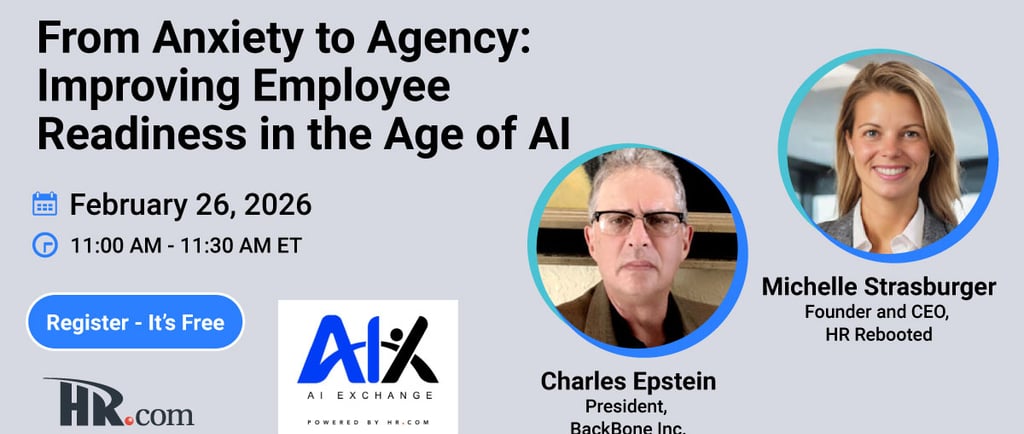
From Anxiety to Agency: Improving Employee Readiness in the Age of AI
This conversation explores why governance is the key to moving organizations from anxiety to agency, giving employees the clarity, confidence, and guardrails they need to engage with AI responsibly while aligning people, policy, and strategy.
a conversation with Charles Epstein and Michelle Strasburger
3/10/20265 min read
From Anxiety to Agency: How HR Can Prepare Employees for the Age of AI
Artificial intelligence is moving faster than most organizations can keep up with.
Employees are experimenting with AI tools. Leaders are trying to understand the opportunity. HR is being asked to guide the workforce through change that is unfolding in real time.
And yet, inside many organizations, one thing is still missing: a clear framework for how AI should be used.
Without that structure, anxiety fills the gap.
In a recent HR.com webcast, Michelle Strasburger, CEO of HR Rebooted, explored why employee anxiety around AI is rising — and how HR leaders can transform that anxiety into agency.
The key? Governance.
AI Anxiety Is Real — Even If the Numbers Don’t Look Dramatic
Research on AI in the workplace suggests that employee anxiety is significant, even when the headline statistics appear moderate.
For example:
40% of employees worry AI could replace parts of their job
35% feel uncertain about their long-term career prospects
At first glance, those numbers may not seem overwhelming.
But look closer.
If 40% of employees believe AI could replace aspects of their role, that represents a meaningful level of uncertainty inside an organization.
And that uncertainty varies by generation.
Younger employees — particularly Gen Z and Millennials — tend to report higher anxiety about AI’s future impact. With decades of career ahead of them, they are asking difficult questions:
Will my role still exist in five years?
Should I invest in education for a job that may change dramatically?
What skills should I actually be developing?
Meanwhile, more experienced employees often feel slightly less anxious. In many cases, experience helps them understand how to use AI tools effectively and ask better questions of the technology.
But across the workforce, one reality remains the same:
People don’t fear AI as much as they fear the unknown.
Adoption Is Lower Than You Think
Another surprising insight from workplace research is how limited AI adoption still is across most organizations.
Leadership teams are experimenting with AI heavily. But usage drops sharply as you move down the organization.
Individual contributors are far less likely to use AI tools regularly.
Why?
Because most organizations have not clearly answered questions like:
Are we allowed to use AI?
Which tools are approved?
What data can we share with AI systems?
How will AI use impact performance evaluations?
Without clarity, many employees choose the safest path: avoid the technology altogether.
Others experiment quietly — creating what many experts call “shadow AI.”
Either scenario creates risk.
The Playground Analogy: Why Governance Enables Innovation
A useful analogy helps explain what’s happening.
Imagine a school playground with no fence.
Children go outside to play, but they stay close to the building. They aren’t sure where the boundaries are, so they avoid exploring the full space.
Now imagine the school installs a fence around the playground.
The next day, the children run all the way to the edge of the yard. The boundaries are clear, so they feel free to explore.
AI governance works the same way.
When employees understand the rules — the guardrails — they feel empowered to experiment and innovate.
Without those boundaries, they hesitate.
Or worse, they experiment without guidance.
Governance Is the Foundation of AI Readiness
When people hear the word governance, they often assume it means heavy compliance or restrictive policies.
But effective AI governance is not about limiting innovation.
It’s about creating the conditions where innovation can happen safely.
A strong governance framework typically includes:
AI strategy aligned with business goals
Governance committees representing key functions
Clear policies for acceptable AI use
Documentation and transparency around AI systems
Training and employee enablement
Oversight for higher-risk applications
At its core, governance ensures that AI is used responsibly, transparently, and intentionally.
It provides organizations with the structure needed to move from experimentation to strategic adoption.
HR Is the Conductor of the AI Orchestra
AI adoption affects far more than technology.
It reshapes:
job roles
performance expectations
culture
communication
organizational design
That’s why HR plays a central role in successful AI transformation.
One way to think about it:
AI is the orchestra. HR is the conductor.
Every department contributes to AI adoption — IT, legal, finance, marketing, operations.
But HR is uniquely positioned to bring those groups together because HR already manages:
workforce transformation
change management
training and development
policy creation
employee communication
organizational culture
In other words, HR already operates at the intersection of people, policy, and business strategy.
And AI touches all three.
The Risks of AI Without Governance
Organizations that adopt AI without governance expose themselves to several categories of risk.
Legal and compliance risk
AI tools can introduce bias into hiring, performance evaluations, or other employment decisions. Even if the bias originates in the technology, the organization is still responsible for the outcome.
Reputational and financial risk
AI failures can quickly become public issues — leading to lawsuits, regulatory scrutiny, and brand damage.
Workforce and cultural risk
If employees feel threatened or excluded from the AI transition, trust erodes and resistance grows.
Operational risk
Unmanaged AI usage can create data security vulnerabilities, intellectual property risks, and inconsistent decision-making.
Governance helps organizations manage these risks while still capturing the benefits of AI innovation.
Moving From Anxiety to Agency: Practical Steps for HR Leaders
Organizations do not need perfect AI strategies to begin.
In fact, waiting for perfect clarity is often what stalls progress.
Instead, HR leaders can begin with practical steps.
1. Define an AI strategy
AI should support the organization’s mission and business goals, not exist as an isolated technology initiative.
2. Start small
Pilot projects allow organizations to learn quickly without overwhelming teams.
3. Invest in AI literacy
Continuous education helps employees understand both the capabilities and limitations of AI tools.
4. Develop clear policies
Employees need guardrails around data usage, acceptable tools, and oversight processes.
5. Communicate frequently
Silence creates speculation. Transparent communication builds trust.
6. Establish governance structures
Cross-functional committees help guide responsible adoption.
7. Keep humans in the loop
Human oversight remains critical for high-impact decisions.
These steps mirror the seven-step governance framework HR Rebooted recommends for organizations implementing AI responsibly.
The Opportunity for HR
AI will undoubtedly change the nature of work.
But that change also creates an opportunity.
HR leaders have the chance to step into a new strategic role — helping organizations redesign work for a future where humans and AI collaborate.
This means shifting from administrative support to strategic workforce architecture:
designing roles where humans supervise AI systems
building new skill pathways for employees
ensuring ethical and transparent AI use
aligning AI adoption with culture and business strategy
As the HR Rebooted philosophy emphasizes, AI governance is ultimately about aligning technology with people and business goals — not the other way around.
The Bottom Line
AI adoption is already happening inside most organizations.
The real question is whether leaders will govern it intentionally or allow it to evolve chaotically.
When organizations provide structure, transparency, and education, employee anxiety begins to fade.
In its place emerges something far more powerful:
Agency.
Employees who understand the rules are more willing to experiment.
Teams that trust the process innovate more confidently.
Organizations that align AI with their people and culture gain a lasting advantage.
And HR is uniquely positioned to lead that transformation.
You can watch the conversation between Charles Epstein and Michelle Strasburger on YouTube.
HR Rebooted
Empowering organizations for the AI Revolution
Join our Email List
info@hrrebooted.com
583 Reed Rd | Colebrook, NH 03576 | 603.490.3703
© 2026. All rights reserved.