
AI Governance in HR: Why It's Time for HR Leaders to Take the Lead Now
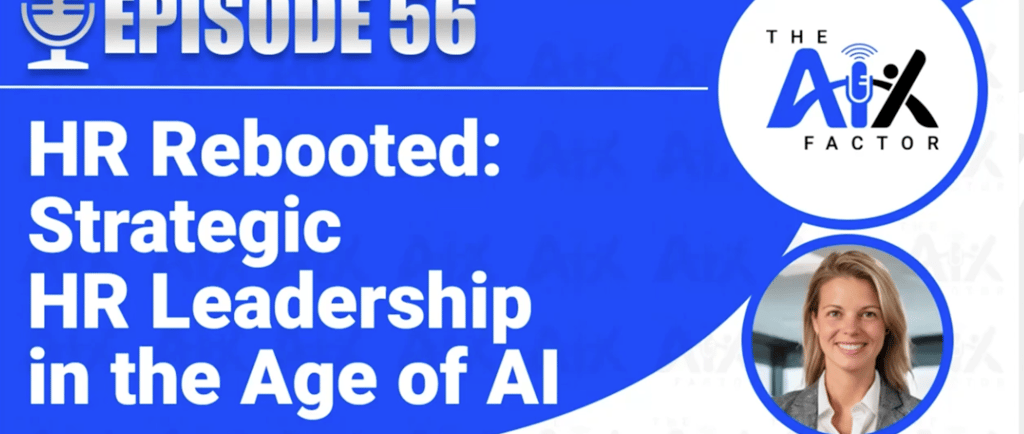
In a conversation on the AIX Factor Podcast, Charles Epstein and Michelle Strasburger, CEO of HR Rebooted, discuss the role of HR in workforce AI governance and the opportunity it presents for strategic HR leadership.
HR Rebooted and the AIX Factor Podcast
1/5/20263 min read
AI Governance in HR: Why HR Leaders Must Take the Lead Now
Artificial intelligence is no longer a future concept in the workplace. It’s already influencing how organizations hire, evaluate performance, plan their workforce, and make decisions. Yet while AI adoption is accelerating, governance, oversight, and employee trust are struggling to keep up.
This growing gap creates both risk and opportunity. And no function is better positioned to lead than HR.
In a recent conversation on the X Factor Podcast, Michelle Strasburger, CEO of HR Rebooted, shared why AI governance has become a defining moment for HR leadership and how organizations can move forward with confidence.
Why AI governance matters in today’s workplace
AI is already embedded in day-to-day work. Employees are using it to write job descriptions, summarize meetings, analyze data, and increase productivity. In many cases, leadership has limited visibility into how and where AI is being used.
In the U.S., the challenge is compounded by limited regulation. While global frameworks and standards like NIST and ISO exist, most organizations are still left to interpret and apply them independently. That leaves HR leaders navigating AI risk, ethics, and compliance without a clear roadmap.
AI governance fills this gap. It provides structure around how AI is used, how decisions are made, and how risks are managed without slowing innovation.
Trust is the biggest barrier to AI adoption
Multiple studies show that lack of trust is the number one obstacle to AI adoption. Employees worry about:
How AI is being used to make decisions
Whether AI introduces bias into hiring or performance management
What AI means for job security
How their personal and company data is being handled
These concerns are justified. Organizations are already facing lawsuits related to biased AI-driven decisions and improper data use.
AI governance directly addresses trust by creating transparency, accountability, and human oversight. When employees understand how AI is used and where people remain part of the decision-making process, fear begins to diminish.
A practical framework for AI governance in HR
One of the biggest challenges for HR leaders is knowing where to start. Effective AI governance does not require perfection on day one. It requires structure.
A strong governance approach typically includes:
Cross-functional governance committees
Involving HR, IT, Legal, Risk, and business leadersDefined AI use cases
Starting small and assigning risk levels to each use caseClear documentation and policies
Including acceptable use, data privacy, and decision transparencyTraining and communication
Teaching employees how to use AI responsibly and effectivelySafeguards and guardrails
Filters, controls, and human oversight to prevent misuse or driftOngoing monitoring and improvement
AI evolves quickly, and governance must evolve with itScaling responsibly
Expanding AI use as confidence, maturity, and trust grow
This type of framework turns AI governance into a repeatable, manageable process rather than a one-time compliance exercise.
Shadow AI is already happening
When organizations ban AI entirely, employees often use it anyway on personal devices or outside approved systems. When organizations allow unrestricted use without policies, sensitive data can easily be exposed.
This “shadow AI” creates significant risk.
The solution is not banning AI or allowing complete freedom. It’s setting clear expectations, enforcing policy, and educating employees so AI use aligns with organizational values and risk tolerance.
Why AI governance is HR’s strategic opportunity
For years, HR has worked to earn a strategic seat at the table. AI makes that opportunity real.
As automation reduces administrative work, HR’s role shifts toward:
Workforce planning using human and AI resources
Ethical oversight of technology
Change management and communication
Upskilling and reskilling employees
Aligning AI use with organizational culture
Employees are already turning to HR with questions about AI, trust, and job security. While HR may not have all the answers, it can provide something equally valuable: a clear process, a thoughtful plan, and ongoing communication.
AI governance and employee wellbeing
Employee wellbeing is directly tied to how AI is introduced and governed. Roughly half of employees report concern about job displacement due to AI. Uncertainty fuels stress, burnout, and disengagement.
Governance helps organizations proactively address these fears by answering critical questions:
How will AI impact roles over time?
How will decisions be made fairly?
What training and career pathways will be available?
When employees know there is a plan and that people remain at the center of decision-making, trust increases and anxiety decreases.
The future of work depends on governance
AI governance is not about slowing progress. It’s about enabling responsible innovation. Organizations that pair AI adoption with governance will move faster, earn more trust, and reduce risk.
This is not just a technology shift. It’s a workforce transformation. And HR has a defining role to play.
HR Rebooted
Empowering organizations for the AI Revolution
Join our Email List
info@hrrebooted.com
583 Reed Rd | Colebrook, NH 03576 | 603.490.3703
© 2026. All rights reserved.