
12 Ways HR Can Lead Confidently with AI
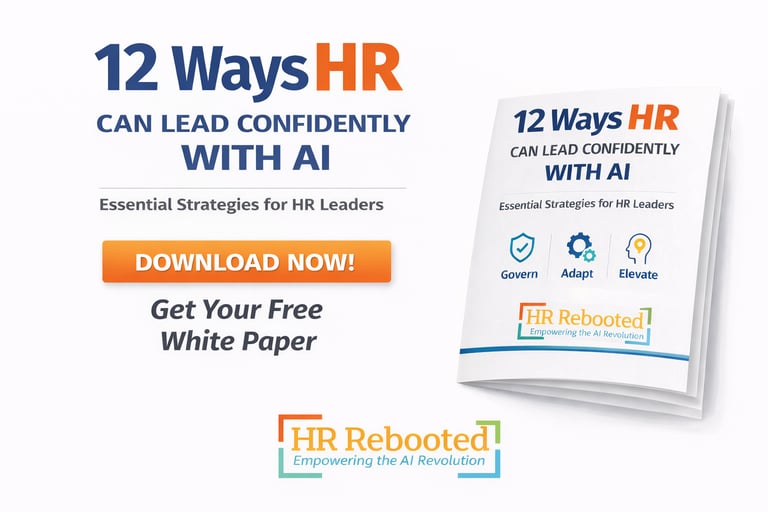
This blog article summarizes the the white paper "12 Ways HR Can Lead Confidently with AI". Download the white paper at the end of the article.
MIchelle Strasburger, CEO, HR Rebooted
2/2/20264 min read
12 Ways HR Can Lead Confidently With AI
Artificial intelligence is no longer a future concept for HR. It is already shaping how work gets done, how decisions are made, and how employees experience their jobs. The challenge is not whether AI will be used, but whether it will be used intentionally, responsibly, and in alignment with the business.
Today, most organizations are in an uncomfortable middle ground. Employees are using AI tools daily. Leaders are asking for productivity gains. Regulations are evolving quickly. Yet governance, education, and clarity are lagging behind. This gap is creating risk, anxiety, and missed opportunity.
The HR Rebooted white paper, 12 Ways HR Can Lead Confidently With AI, outlines how HR can step into this moment with authority and purpose. Not as a blocker or rule enforcer, but as the function best positioned to align people, policy, culture, and strategy as AI adoption accelerates.
Why HR Must Lead
AI is often treated as a technical issue or a legal concern. In reality, it is a people issue. AI impacts hiring, performance, communication, learning, job design, and trust. That makes HR the natural owner of AI governance.
HR already manages employment law compliance, organizational change, culture, and workforce risk. AI simply extends that responsibility into a new domain. When HR leads AI governance, organizations gain clarity instead of chaos and confidence instead of fear.
The Reality Inside Most Organizations
AI usage is extensive but largely invisible. Employees experiment quietly because they are unsure what is allowed. Leaders lack visibility into how AI is influencing work and decisions. Restrictive policies often drive usage underground, increasing risk rather than reducing it.
Without governance, organizations face real consequences. Legal and regulatory exposure, reputational damage, biased decision-making, intellectual property risk, and employee resistance all increase when AI is unmanaged. High-profile lawsuits and regulatory actions already show what happens when organizations fail to act.
What AI Governance Really Means
AI governance is not about control for control’s sake. It is a practical framework that enables responsible adoption while protecting the business and its people. Effective AI governance includes clear policies, risk-based decision-making, documentation, training, and continuous monitoring.
Most importantly, it creates alignment. AI should support the organization’s mission, reinforce culture, and strengthen trust rather than undermine it.
The 12 Ways HR Can Lead Confidently With AI
The white paper outlines twelve practical actions HR leaders can take today. These actions are designed to be realistic, scalable, and human-centered.
HR can start by defining a clear AI-driven strategy that aligns with business goals instead of reacting to ad hoc tool adoption. Rather than trying to solve everything at once, HR should prioritize use cases and focus on areas with the greatest impact and risk.
Education is critical. HR must continuously build AI literacy across the organization so employees understand not just how to use AI, but how to use it responsibly. This includes understanding risks, bias, data privacy, and appropriate use.
Assessing the current state of AI usage is another foundational step. Organizations cannot manage what they do not measure. HR should work with leaders to understand where AI is already being used and where gaps exist.
From there, policies should be developed, communicated, and iterated. Effective policies are clear and practical, not overly restrictive. They provide guardrails without shutting down innovation.
HR must also help organizations move from experimentation to leadership. AI should not remain a series of isolated experiments. With governance in place, organizations can scale AI adoption with confidence.
Transparent communication matters. Employees are worried about job impact, fairness, and surveillance. HR plays a critical role in addressing fears, setting expectations, and reinforcing that AI is meant to support people, not replace them.
Partnership is another theme. HR should work closely with legal, IT, and business leaders, while maintaining ownership of governance. No single function can do this alone, but HR is best positioned to coordinate.
Human-centered AI must remain a core principle. Bias mitigation, ethical decision-making, and fairness are not optional. They are essential to maintaining trust and protecting the organization.
HR must also help prepare the workforce for the future of work. AI will change roles, skills, and expectations. Training, reskilling, and workforce planning are critical to long-term success.
Finally, HR must guide change management and adoption. AI introduces uncertainty, and unmanaged change creates resistance. HR’s expertise in organizational change is essential to successful AI integration.
A Practical Framework That Scales
The white paper introduces a simple, seven-step governance framework that organizations can adopt and grow over time. It emphasizes forming a cross-functional governance committee, using a risk-based tier system, documenting AI usage, addressing employee concerns, implementing safeguards, monitoring outcomes, and preparing for future growth.
This approach recognizes that governance is not a one-time project. It evolves as AI capabilities, regulations, and business needs change.
From Risk to Advantage
When AI governance is absent, risk grows quietly. When governance is intentional, AI becomes an advantage. Organizations gain visibility into how AI is used, employees feel safer and more confident, and leaders can make informed decisions.
The difference between organizations that thrive with AI and those that struggle will come down to alignment. Alignment between strategy and technology. Between innovation and ethics. Between productivity and humanity.
HR’s Moment to Lead
AI is reshaping the workplace whether organizations are ready or not. HR has a unique opportunity to lead this shift with clarity, confidence, and credibility.
The question is no longer whether HR should be involved in AI governance. The question is whether HR will lead it.
HR Rebooted
Empowering organizations for the AI Revolution
Join our Email List
info@hrrebooted.com
583 Reed Rd | Colebrook, NH 03576 | 603.490.3703
© 2026. All rights reserved.